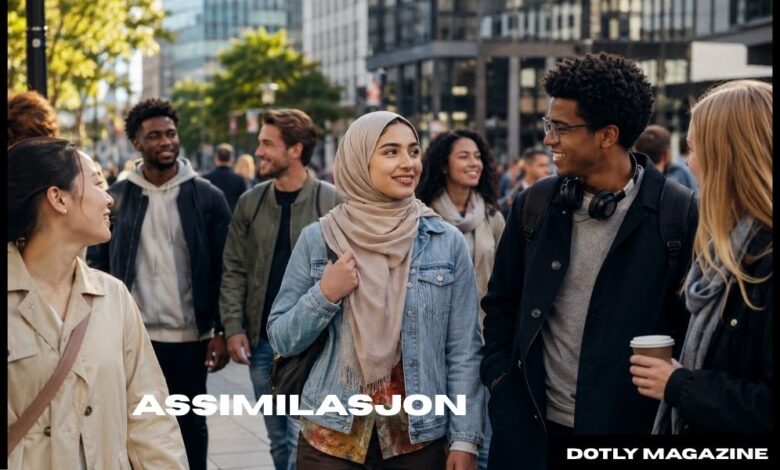
Assimilasjon is a Norwegian word that translates to assimilation in English. It describes the process where something becomes more similar to something else, whether that means a person adapting to a new culture, a language sound changing because of another sound, or a new idea being absorbed into existing knowledge. Cambridge Dictionary translates “assimilasjon” as assimilation and explains it as becoming closer to or more like something, including language sounds and ethnic groups.
| Quick Info | Details |
|---|---|
| Focus Keyword | Assimilasjon |
| English Meaning | Assimilation |
| Language | Norwegian |
| Main Use | Society, culture, language, psychology, and biology |
| Social Meaning | A group or person adopts traits of a dominant culture |
| Linguistic Meaning | One sound becomes more like another sound |
| Key Concern | It can support integration, but it can also erase identity if forced |
What Does Assimilasjon Mean?
Assimilasjon means a process of becoming similar, blending in, or being absorbed into another system. In everyday social discussion, it often refers to immigrants, minorities, or cultural groups adopting the language, customs, values, and habits of a larger society.
Britannica defines assimilation in sociology and anthropology as the process where individuals or groups of different ethnic heritage are absorbed into the dominant culture of a society. It also explains that assimilation can become the most extreme form of acculturation when the assimilating group becomes socially indistinguishable from the dominant group.
In simple words, assimilasjon happens when difference becomes reduced. Sometimes this happens naturally over time. Sometimes it happens because people feel pressure to fit in. In the worst cases, it can be forced by governments, schools, laws, or social discrimination.
Why People Search for Assimilasjon
People search for Assimilasjon because it is used in several important fields. A student may see it in a sociology textbook. A language learner may find it in a Norwegian dictionary. A reader may hear it in debates about immigration, culture, minorities, or national identity.
The word also has academic value because it does not mean only one thing. It can describe cultural change, language change, psychological learning, or biological processes. The Norwegian Academy Dictionary includes several meanings, including psychological assimilation, where new experience is worked into existing knowledge, and botanical assimilation, where plants take up inorganic substances and transform them into organic material.
This wide use makes Assimilasjon a powerful keyword. It is simple on the surface but deep when explored properly.
Assimilasjon in Society
In society, Assimilasjon usually means that a minority group becomes more like the majority group. This may involve language, clothing, food habits, religion, public behavior, values, education, or national identity.
For example, a family that moves to a new country may begin speaking the majority language at work and school. Their children may adopt local slang, local holidays, and local social habits. Over time, they may feel more connected to the new society than to their original culture.
This can be positive when people adapt freely and gain access to education, work, and social belonging. However, it becomes harmful when people are pressured to abandon their own language, traditions, names, religion, or identity to be accepted.
Assimilasjon vs Integration
Assimilasjon and integration are often confused, but they are not the same. Integration means joining a society while still keeping important parts of one’s own identity. Assimilation often suggests becoming more like the dominant culture, sometimes at the cost of original identity.
For example, integration may allow a person to speak the national language while also speaking their family language at home. Assimilation may pressure that person to stop using the family language altogether.
This difference matters in modern society. Many countries now try to promote integration rather than forced assimilation because diversity can strengthen communities when people are included fairly.
Assimilasjon and Culture
Cultural Assimilasjon happens when people adopt the customs, language, values, and lifestyle of another culture. This can happen through school, work, friendships, media, marriage, migration, and everyday contact.
Sometimes cultural assimilation happens slowly and naturally. A person may enjoy local food, learn local humor, and celebrate new holidays without losing their original identity. But sometimes assimilation becomes a demand. A society may tell minority groups that they must change to be accepted.
That is where the debate begins. Is Assimilasjon helping people belong, or is it asking them to erase themselves? The answer depends on whether the process is voluntary, respectful, and equal.
Assimilasjon and Language
Assimilasjon also has a special meaning in linguistics. In language study, assimilation happens when one speech sound influences another so that they become more alike.
Store norske leksikon explains that in linguistics, assimilasjon means one language sound affects another so they become completely or partly similar. If the sounds are next to each other, it is called contact assimilation; if there is distance between them, it is called distant assimilation.
A simple example in English is how people often pronounce “input” closer to “imput” because the sound changes near another sound. This kind of sound change is natural and common in many languages.
Assimilasjon in Psychology
In psychology, Assimilasjon can describe how people understand new experiences by fitting them into what they already know. The Norwegian Academy Dictionary explains this meaning as integrating new experiences as a confirming addition to previously acquired knowledge.
For example, a child who knows what a dog is may see a wolf and first call it a dog because it fits their existing mental category. Later, they may learn the difference and adjust their understanding.
This psychological meaning is important because it shows that assimilation is not only social. It also happens inside the mind. Humans often understand new things by connecting them to old knowledge.
Assimilasjon in Biology
Assimilasjon can also appear in biology. In this context, it refers to how living organisms absorb and transform substances. For plants, assimilation may involve taking in inorganic materials and turning them into organic matter through natural processes.
This meaning is different from cultural assimilation, but the basic idea is similar. Something is taken in, processed, and made part of a larger system.
Because the word has this scientific use, context is very important. Assimilasjon in a biology class does not mean the same thing as Assimilasjon in an immigration debate.
Historical Examples of Assimilasjon
History includes many examples of forced assimilation. Governments have sometimes tried to make minority groups abandon their language, culture, religion, or traditional lifestyle in the name of national unity.
One well-known Norwegian example is Norwegianization, a policy aimed at assimilating Sámi, Kven, and Forest Finn populations into a more uniform Norwegian identity. Public historical summaries describe Norwegianization as an official policy directed at these groups, with the goal of assimilating non-Norwegian-speaking native populations into an ethnically and culturally uniform Norwegian population.
This history shows why the word Assimilasjon can be sensitive. For some people, it does not only mean adaptation. It also means cultural loss, pressure, and injustice.
Assimilasjon and the Sámi Experience
The Sámi experience is an important example when discussing assimilation in Norway. A 2025 academic reference on the legacy of Sámi assimilation notes that policies aimed to assimilate the Sámi into Norwegian society, with schools used as a key instrument, and that these processes undermined Sámi culture and language.
This example helps explain why forced Assimilasjon is criticized today. Language and culture are not small details. They are part of identity, memory, family, and community.
When a state pressures people to leave their language or traditions behind, the damage can last for generations. That is why modern discussions often focus on reconciliation, cultural protection, and minority rights.
Voluntary Assimilasjon
Not all assimilation is forced. Sometimes people voluntarily adopt parts of another culture because it helps them communicate, work, study, or feel included.
For example, an immigrant may choose to learn the local language because it opens opportunities. A student studying abroad may adopt local customs to build friendships. A family may celebrate new holidays because they enjoy them.
Voluntary Assimilasjon can be empowering when people keep the freedom to choose. The key difference is control. If a person chooses adaptation while keeping dignity and cultural roots, the process can be healthy.
Forced Assimilasjon
Forced Assimilasjon is different. It happens when people are pressured or required to abandon their identity. This pressure can come from laws, schools, employers, media, social prejudice, or government policy.
Examples include banning minority languages in schools, forcing children to change names, punishing traditional clothing, or treating minority customs as inferior.
Forced assimilation is harmful because it tells people that their original identity is a problem. Instead of creating unity, it often creates shame, trauma, and social division.
Assimilasjon and Immigration
Immigration is one of the most common areas where Assimilasjon is discussed. When people move to a new country, they often face the question of how much they should adapt.
Learning the national language, understanding laws, and joining public life can help immigrants succeed. However, expecting immigrants to erase their original culture can be unfair and unrealistic.
Healthy societies usually look for balance. They encourage participation while respecting diversity. That balance is closer to integration than strict assimilation.
Assimilasjon and Identity
Identity is at the center of every assimilation debate. People do not only belong to one category. A person can be Norwegian and Pakistani, British and Somali, French and Algerian, or American and Mexican. Identity can be layered.
Assimilasjon becomes difficult when society demands only one identity. Human beings are more complex than that. They can carry multiple languages, foods, memories, values, and traditions.
Modern multicultural societies often recognize that people should not have to choose between belonging and heritage. They can do both.
Assimilasjon in Education
Schools play a major role in assimilation. They teach language, history, social rules, and national values. This can help children succeed in society. However, schools can also become tools of forced assimilation if they shame or erase minority identity.
A fair education system teaches shared knowledge while respecting cultural background. It does not punish children for speaking a family language. It does not treat minority history as unimportant. It does not force students to hide who they are.
Education can either support inclusion or create cultural loss. That is why Assimilasjon in schools must be handled carefully.
Assimilasjon in Modern Workplaces
Workplaces also shape assimilation. New employees often learn the culture of a company. They adapt to communication styles, dress codes, work habits, and professional expectations.
Some workplace assimilation is normal. Every organization needs shared rules. But problems arise when employees from minority backgrounds feel they must hide accents, hairstyles, religious practices, cultural food, or personal identity to be accepted.
A better workplace culture encourages professionalism without demanding personal erasure. Inclusion means people can contribute fully without pretending to be someone else.
Assimilasjon and Globalization
Globalization has made assimilation more complex. People move, study, work, and communicate across borders more than ever. Cultures influence each other through music, film, fashion, food, language, and social media.
This creates cultural mixing. Some people see this as enrichment. Others worry that smaller cultures may be swallowed by larger global cultures.
Assimilasjon in globalization is not always controlled by one government. It can happen through media power, economic pressure, and global trends. For example, English-language media can influence local languages and youth culture around the world.
Assimilasjon vs Acculturation
Acculturation is another related term. Britannica explains acculturation as the processes of change in customs, artifacts, and beliefs that result from contact between two or more cultures.
Assimilation is more specific and often more complete. Acculturation can happen when cultures influence each other while remaining distinct. Assimilation suggests one group becomes absorbed into another.
For example, eating food from another culture is acculturation. Losing your original language and becoming indistinguishable from the dominant group is closer to assimilation.
The Positive Side of Assimilasjon
Assimilasjon can have positive effects when it is voluntary and respectful. It can help people communicate, build friendships, find jobs, and participate in society. It can reduce isolation and create shared understanding.
For immigrants, learning a new language and social system can be life-changing. It can open doors to education, legal rights, healthcare, and public participation.
The positive side appears when adaptation is a tool, not a demand. People should be able to adapt without being forced to abandon their roots.
The Negative Side of Assimilasjon
The negative side of Assimilasjon appears when power is unequal. If the dominant group controls what counts as “normal,” minority groups may feel pressured to change in order to survive.
This can lead to language loss, cultural shame, identity confusion, and generational trauma. Children may grow up disconnected from grandparents. Communities may lose traditional knowledge. Minority languages may disappear.
That is why many scholars, activists, and educators prefer models that protect cultural identity while encouraging social participation.
Is Assimilasjon Always Bad?
Assimilasjon is not always bad. It depends on context. Voluntary adaptation can be useful and healthy. Forced assimilation can be damaging and unjust.
The question is not only “Are people adapting?” The better question is “Do people have a choice?” If people are free to keep their language, culture, and identity while also joining wider society, the process is much more balanced.
When assimilation becomes a condition for dignity or acceptance, it becomes a problem.
Why Assimilasjon Still Matters Today
Assimilasjon matters today because societies are becoming more diverse. Migration, globalization, and digital culture bring people from different backgrounds into closer contact.
Countries must decide how to build shared belonging without erasing difference. Schools must decide how to teach national identity while respecting minority history. Workplaces must decide how to create unity without forcing everyone to act the same.
These are not old questions. They are active modern challenges. That is why understanding Assimilasjon is still important.
Final Thoughts on Assimilasjon
Assimilasjon is a rich and important word. In Norwegian, it translates to assimilation, but its meaning changes depending on context. It can describe cultural adaptation, language sound change, psychological learning, or biological absorption.
In society, Assimilasjon can help people participate in a new community when it is voluntary and respectful. But when it is forced, it can erase identity, damage minority cultures, and create long-term harm.
The best way to understand Assimilasjon is to see both sides. It can mean learning and belonging, but it can also mean pressure and loss. A fair society should not demand that people erase themselves to be accepted. Instead, it should create space for shared life, mutual respect, and cultural dignity.
FAQs About Assimilasjon
What does Assimilasjon mean?
Assimilasjon is a Norwegian word that means assimilation in English. It describes a process where something becomes more similar to something else.
What is Assimilasjon in society?
In society, Assimilasjon means a person or group adopts the language, customs, values, or lifestyle of a dominant culture.
Is Assimilasjon the same as integration?
No. Integration allows people to join society while keeping important parts of their identity. Assimilation often means becoming more like the dominant group, sometimes by losing original cultural traits.
What is linguistic Assimilasjon?
In linguistics, Assimilasjon happens when one speech sound influences another sound so they become more similar.
What is psychological Assimilasjon?
In psychology, Assimilasjon means fitting new experiences into existing knowledge or mental frameworks.
Can Assimilasjon be positive?
Yes. It can be positive when people freely choose to adapt in ways that help them communicate, work, study, and participate in society.
Can Assimilasjon be harmful?
Yes. It can be harmful when people are forced to abandon their language, culture, religion, names, or identity.
What is an example of forced Assimilasjon?
Norwegianization is one historical example, where policies aimed to assimilate Sámi, Kven, and Forest Finn populations into a uniform Norwegian identity.
Why is Assimilasjon important today?
It is important because modern societies must balance shared belonging with respect for cultural diversity, minority rights, and personal identity.
What is the simple meaning of Assimilasjon?
The simple meaning of Assimilasjon is becoming more like something else or being absorbed into another system.
Visit for more info Dotlymagazine.co.uk